
 By James Anderson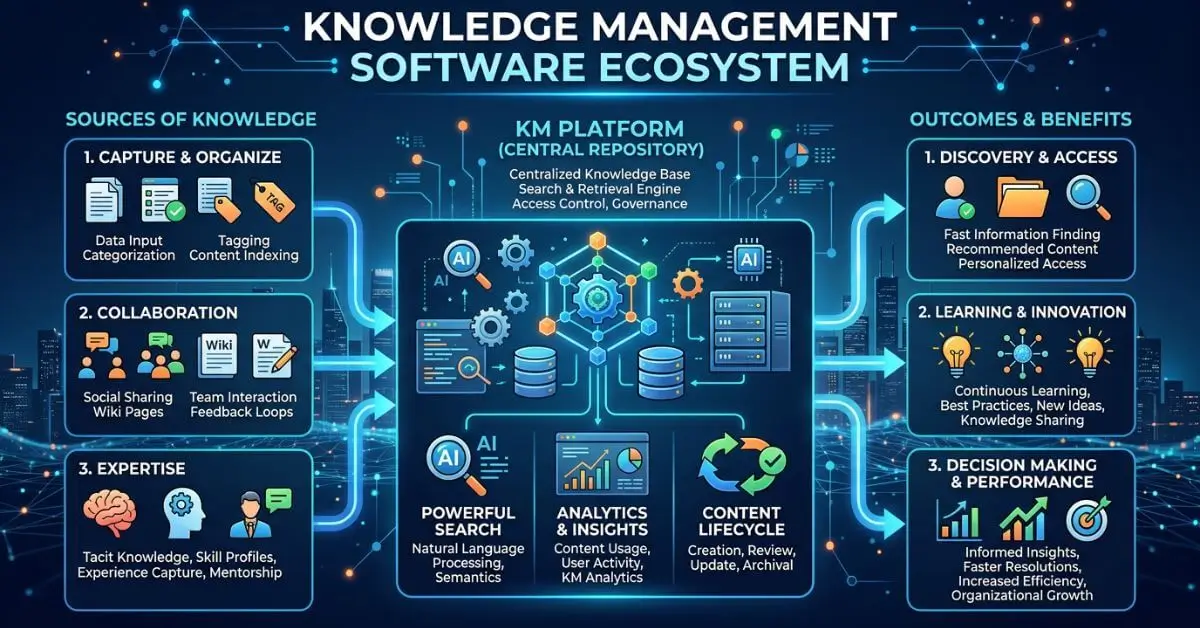
Businesses generate vast amounts of data daily, yet finding an efficient method to organize this information is a challenge many face. A study reveals that employees spend about 20% of their time searching for the information needed to perform their duties effectively, which equates to one full day out of a five-day workweek.
The adoption of knowledge management software streamlines processes by organizing data into a cohesive system, facilitating quick information retrieval and improving productivity. Below, we explore the benefits and actionable strategies that businesses can employ to harness the full potential of these systems.
Incorporating knowledge management software into a business environment significantly enhances the ability to retrieve information when needed. This software acts as a central repository, making data readily available to employees, which reduces downtime and boosts productivity.
For instance, companies report a reduction in search times by as much as 35% after implementing robust knowledge management systems. Such efficiency not only affects time management but also contributes to employee satisfaction as employees feel more empowered and less frustrated.
knowledge management software To capitalize on these benefits, companies should evaluate their information architecture and taxonomy. Providing training sessions on utilizing these databases effectively can also ensure that employees are well-equipped to access information without delay.
Centralized data provided by knowledge management systems is a foundational asset for informed decision making. The ability to quickly analyze data from various sources allows for quicker and more accurate decisions, which is vital in an agile business environment.
Companies that implement these systems notice a marked improvement in the quality of their decision-making due to the comprehensive, accurate, and timely information at their fingertips. Decision-makers can rely on a single source of truth, which minimizes the risks of errors or misinterpretation that often come with fragmented data.
As an actionable measure, businesses should look to integrate analytics capabilities within their knowledge management platforms. This integration can provide insights and trends that help guide strategic decisions, fostering a data-driven culture within the organization.
Knowledge management software removes silos and promotes a collaborative work environment by sharing insights across departments. This openness fosters innovation as employees build upon peers’ knowledge and collectively address challenges.
Statistics have shown that collaborative workspaces can lead to a 30% increase in productivity. The networked nature of knowledge management software means that expertise can be shared in real-time, thus accelerating problem-solving and innovative thinking.
To enhance collaboration, organizations should encourage the use of knowledge management tools for project documentation and lessons learned. Integration with collaborative platforms like Slack or Microsoft Teams can amplify the effectiveness of knowledge sharing and resolution of complex tasks.
Assessing the impact of knowledge management on operational efficiency involves analyzing metrics such as time savings, resource allocations, and cost reductions. Companies often notice a positive return on investment shortly after implementing a knowledge management system due to the streamlining of internal processes.
For example, a company may find that their customer service response times have decreased by 25% since leveraging a knowledge management system, translating into improved customer satisfaction ratings. This kind of measurable impact reinforces the value these systems bring to an organization.
Organizations can conduct regular audits and leverage data analytics to track these efficiencies over time. Regular reviews can also identify areas for improvement, ensuring that the knowledge management system evolves with the company’s changing needs.
In conclusion, the implementation of knowledge management software serves as a catalyst for business efficiency, enhancing information accessibility, decision-making, collaboration, and measurable operational success. By streamlining data management and distribution, companies can make more informed choices, foster a collaborative culture, and continuously measure the positive impacts on their operations.