
 By James Anderson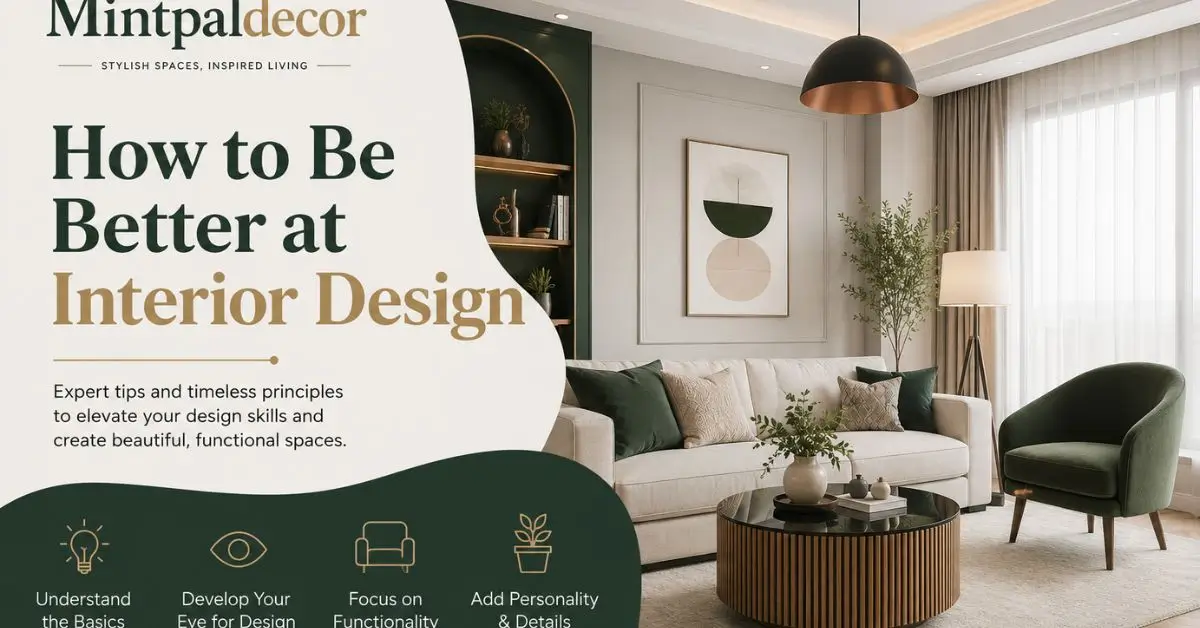
Most people who want to improve their interior design skills make the same mistake. They look at more images. They follow more accounts. They consume more inspiration. And then they stand in their own rooms, confronted with the same decisions they always have been, and find that the inspiration does not translate into clarity about what to actually do.
Getting better at interior design is not primarily about gathering more inspiration. It is about developing the specific judgment, knowledge, and habits that allow you to make confident decisions about space, proportion, light, color, and texture in your actual rooms with your actual constraints.
Learning how to be better at interior design mintpaldecor style means developing this kind of principled, practical design thinking rather than just consuming more aspirational content. This guide covers the specific skills, principles, and habits that produce genuine improvement.
How to be better at interior design mintpaldecor refers to the practical approach to developing interior design skills advocated by the mintpaldecor platform, focusing on building design judgment, understanding foundational principles, cultivating observation habits, and making more intentional decisions about space, light, color, proportion, and styling. The goal is developing genuine design capability rather than simply accumulating inspiration or product knowledge.
Getting better at interior design requires developing specific skills: learning to see proportion and scale accurately, understanding how light affects everything, building a working knowledge of color relationships, and developing the habit of editing before adding. The mintpaldecor approach focuses on principled thinking that improves every decision rather than trend-following that requires constant updating. This guide covers exactly how to build these skills.
Understanding why most homeowners do not improve their design skills despite wanting to helps explain what actually works.
The most common pattern is what might be called inspiration consumption without principle development. You look at beautiful rooms. You notice you find certain things appealing. You try to replicate elements you liked. The result does not look quite right and you are not sure why.
This pattern stalls because beautiful rooms are made by designers who have internalized principles that determine which elements work together and which do not, what scale and proportion feel right, how light needs to be managed, and what color relationships create coherence. Without those principles, copying individual elements produces results that have the pieces without the logic that made them work.
The mintpaldecor approach to how to be better at interior design is built around developing those principles rather than copying outcomes.
The most consistent mistake in interior design is not choosing the wrong style. It is choosing the wrong scale. A sofa too small for a room, a rug that does not anchor the furniture, artwork hung at the wrong height, all of these problems stem from an underdeveloped ability to assess how objects relate to the space they occupy.
Practice the before-and-after test
The fastest way to develop proportion awareness is to photograph a room before and after making a change. Photographs flatten space in ways that reveal proportion problems your eye adjusts to when you are standing in the room. A rug that looks fine when you are standing beside the sofa often reveals itself as obviously undersized in a photograph. Train your eye to see proportion the way a camera does.
Use tape on the floor before buying furniture
Laying masking tape on the floor in the footprint of furniture you are considering purchasing is one of the most valuable habits any interior design learner can develop. It costs nothing, takes five minutes, and prevents the most expensive design mistakes. A sofa that seemed like the right size in the showroom often looks completely wrong once you have mapped its footprint in your actual room.
Learn the standard proportion guidelines
Certain proportion relationships appear consistently in well-designed rooms because they work reliably. Rugs should be large enough for the front legs of all main seating to sit on them. Artwork should be hung so its center falls at approximately eye level, typically 57 to 60 inches from the floor. Curtain rods should be mounted close to the ceiling, not at the window frame. These are not arbitrary rules. They are guidelines derived from what consistently produces visually resolved spaces.
Light is the element that most dramatically affects how every other element in a room looks and feels, and it is the element that homeowners most consistently underestimate and underinvest in.
Observe how light changes throughout the day
The most important exercise for developing light awareness is simply watching. Spend a day in a room you want to understand better and notice how the quality of natural light changes from morning to afternoon to evening. Notice which areas are consistently bright, which are consistently shadowed, and how the color temperature of the light changes across the day.
This observation directly informs decisions about where artificial lighting is most needed, which wall colors will read correctly under the room’s natural light conditions, and where plants and furniture should be positioned relative to light sources.
Understand color temperature in artificial lighting
The color temperature of light bulbs, measured in Kelvins, dramatically affects how every color and material in a room looks. Cool white or daylight bulbs in the 4000K to 6500K range make colors look harsh and spaces feel clinical. Warm white bulbs in the 2700K range make colors look richer and spaces feel more inviting.
Switching from cool to warm bulbs is often the single highest-return design change available in any room. The cost is minimal. The effect on atmosphere is dramatic. This is how to be better at interior design Mintpaldecor identifies as one of the fastest ways to see immediate, significant improvement.
Layer light sources deliberately
Better at interior design means understanding that rooms need multiple light sources at different heights to feel dimensionally complete. A room lit only by overhead fixtures has flat, institutional lighting regardless of the quality of the fixture. Adding floor lamps for ambient light at eye level, table lamps for intimate reading light, and dimmer control on overhead fixtures creates a room that can serve different purposes and feels genuinely designed.
Color is the design element with the widest reach and the most consistently misunderstood principles. Developing genuine color competency transforms every design decision that follows.
Learn to read undertones before choosing colors
Paint colors have undertones, secondary color influences within the primary color, that determine how they interact with other colors and with the light in a specific room. A gray with blue undertones will look completely different in a room with warm orange-toned wood floors than it will in a room with cool white tile. Learning to identify undertones before committing to a color prevents the most common paint selection mistakes.
Test potential colors by painting large swatches directly on the wall and observing them across different times of day. Small paint chips in a store are nearly useless for accurately predicting how a color will look in a specific room under specific lighting conditions.
Understand how colors relate to each other
Rooms that feel cohesive use colors that relate to each other through shared undertones, complementary positions on the color wheel, or consistent temperature. Rooms that feel chaotic typically have colors that compete rather than coordinate.
The 60-30-10 rule, sixty percent dominant neutral, thirty percent secondary color, ten percent accent, provides a reliable starting framework for understanding how to proportion color in a room. Apply it to walls, upholstery, and accessories together rather than to any single element.
Create a whole-home palette before individual room decisions
How to be better at interior design mintpaldecor consistently emphasizes this: rooms that feel cohesive across the whole home share color language even if each room has its own distinct character. Establishing two or three anchor colors that appear consistently across different rooms in different proportions creates the visual flow that makes a home feel designed rather than accumulated.
The single most transformative habit change for interior design improvement is developing the consistent practice of editing before adding. Most homeowners’ first instinct when a room does not feel right is to add something. Most professional designers’ first instinct is to remove something.
Walk through each room and ask one question per object
For every object in a room, ask: does this contribute to the room’s purpose and character, or is it simply here because it has always been here? Objects that cannot pass this test should be removed before any design decisions are made.
This exercise consistently reveals that most rooms contain more objects than they need, and that removing the excess reveals a better space requiring fewer additional purchases than you expected.
Resist the urge to fill empty space
Empty space in a room is not a problem. It is a design element. Negative space allows the eye to rest, gives important elements room to breathe visually, and creates the sense of calm that well-designed rooms communicate. Learning to be comfortable with and even intentional about empty space is one of the clearest markers of advancing interior design skill.
| Mistake | Why It Happens | How to Avoid It |
|---|---|---|
| Rug too small | Underestimating room scale | Use 8×10 minimum, test with tape |
| Furniture against walls | Trying to maximize floor space | Pull into groupings around focal point |
| All overhead lighting | One fixture feels sufficient | Add floor and table lamps |
| Too many accent colors | Each piece chosen independently | Establish palette before purchasing |
| Hanging art too high | Natural instinct to hang high | Center at 57 to 60 inches from floor |
| Over-accessorizing | Adding without editing | Edit first, then add selectively |
| Ignoring undertones | Choosing color from small chips | Test large swatches on actual walls |
Skill development requires consistent practice over time, not just reading about principles. These habits build design eye progressively.
Analyze spaces you respond to
When you enter a space, a restaurant, a hotel lobby, a friend’s home, that makes a strong impression on you, pause and analyze why it works rather than just feeling that it does. What is the focal point? How is light layered? What is the color palette and proportion? What has been left out that could have been included? This analytical habit develops the vocabulary and framework you need to make similar decisions in your own spaces.
Study design principles, not just design images
Reading about color theory, proportion, spatial planning, and material relationships gives you the conceptual framework that transforms inspiration from something you feel into something you can analyze and apply. How to be better at interior design mintpaldecor involves understanding why beautiful rooms work, not just recognizing that they do.
Make one change at a time and observe the result
Changing multiple elements in a room simultaneously makes it impossible to understand what produced the result. Making one deliberate change, observing its effect, and learning from what you see develops design judgment more effectively than any number of simultaneous changes.
Getting better at interior design is a skill development process, not an inspiration collection process. The mintpaldecor approach to this improvement focuses on building the foundational judgment, principled knowledge, and practical habits that make every design decision more confident and more effective.
Start with proportion and scale. They affect everything and they are learnable through specific practice. Add lighting understanding next, because it transforms results without requiring any additional purchases. Develop color knowledge progressively. And build the edit-first habit that prevents the accumulation that undermines even well-considered design.
Every room you live in is an opportunity to practice. Approach each one with the analytical curiosity of someone developing a skill rather than the frustration of someone who cannot replicate what they see online, and the improvement follows naturally.
If this guide helped you think more clearly about how to develop design skill, explore our related articles on understanding color theory for home decorators and how professional designers approach furniture arrangement. Both give you the next layer of principled knowledge to practice with.
Focus on core principles like proportion, lighting, color balance, and furniture placement rather than following trends.
Understanding proportion and scale is essential, as it helps rooms feel balanced and visually appealing.
Study well-designed spaces, analyze why they work, and experiment with small changes in your own home.
Most online images are professionally staged and edited. Strong design principles matter more than copying exact looks.
With consistent practice and learning, noticeable improvement can happen within a few months.
It focuses on timeless design principles, thoughtful space planning, proper lighting, and intentional styling rather than chasing trends.